
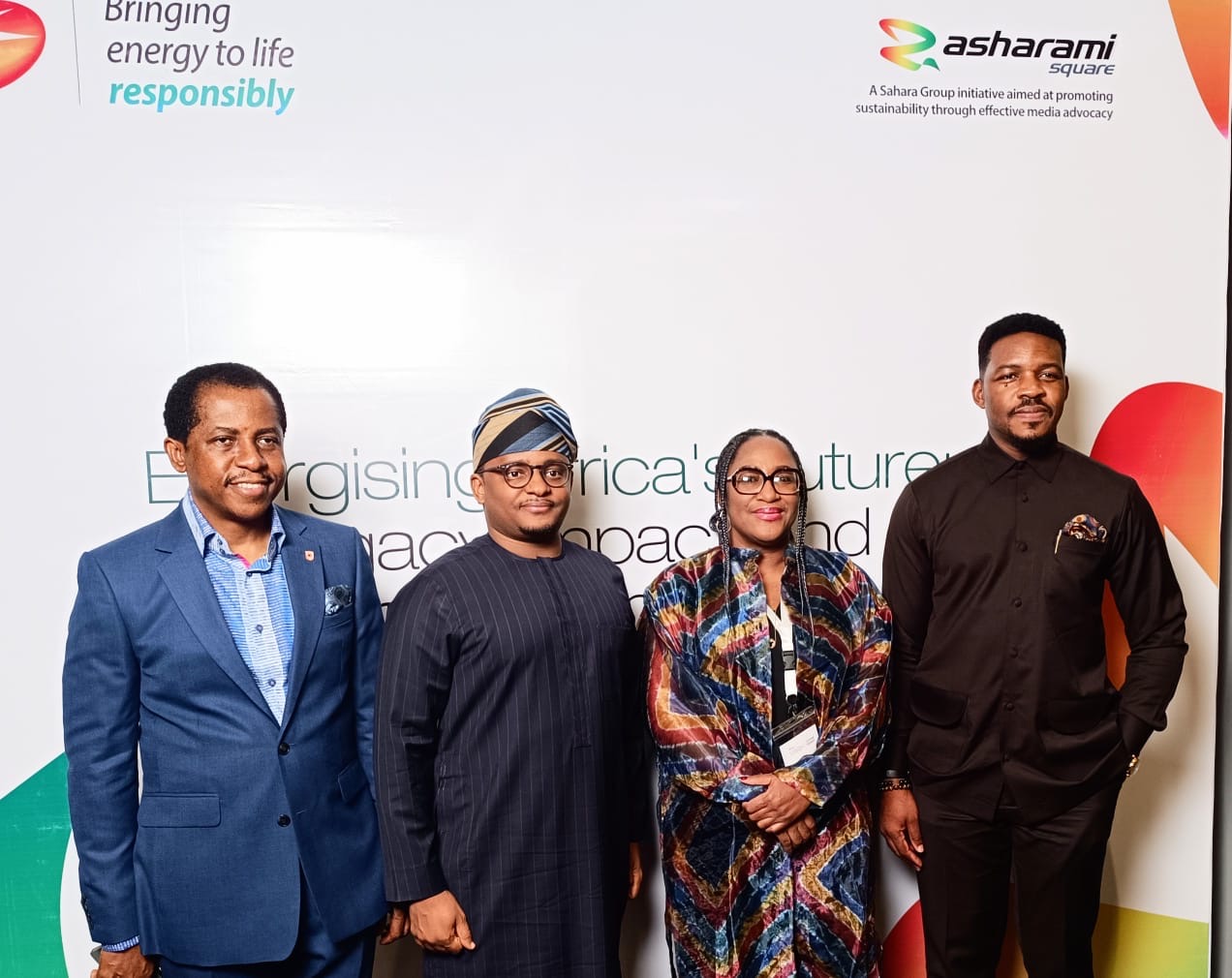
Sahara Group Challenges Africa to Rethink Energy, Investment and Journalism
At Asharami Square 3.0, Sahara Group and industry leaders identified weak governance, poorly prepared projects and inadequate accountability as major barriers to energy investment.
Sahara Group and industry leaders urge sweeping reforms in infrastructure financing, investment readiness and journalism to accelerate the continent’s energy transition
Africa must rethink how it finances, governs and reports its energy transition if the continent is to overcome persistent electricity shortages and unlock sustainable growth, energy-sector leaders have said.
The call emerged at the third edition of Asharami Square, Sahara Group’s thought-leadership platform, in Lagos on Wednesday.
At the heart of the discussions was a stark conclusion: Africa already has many of the technologies and financial resources needed to transform its energy sector, but weak governance, poorly prepared projects and limited access to long-term capital continue to impede progress.
“The issue is no longer technology,” said Sadiq Wanka, Special Adviser to the President on Power Infrastructure, in his keynote address. “The real challenge is mobilising capital at scale, structuring bankable opportunities and creating an ecosystem that attracts long-term financing.”
Wanka said ongoing reforms in Nigeria’s electricity industry were creating investment opportunities across embedded generation, mini-grids, renewable energy, transmission infrastructure and industrial power solutions.
However, converting those opportunities into reliable electricity will require stronger institutions, credible project structures and greater investor confidence.
Africa has capital — but projects must be bankable
A panel examining who will finance Africa’s energy future concluded that the continent possesses significant pools of capital capable of supporting major infrastructure projects.
The challenge, panelists said, is unlocking those resources through transparency, sound governance and better project preparation.
Kemi Awodein, Managing Director of Investment Banking at Chapel Hill Denham, argued that domestic financing could play a decisive role in closing Africa’s infrastructure gap.
“Nigeria has demonstrated that domestic capital can finance transformational infrastructure at scale,” she said. “The real differentiator is governance, transparency and a clear pathway to value creation.”
Temitope George, Chief Executive Officer of the Lagos State Electricity Regulatory Commission, also stressed that investors are more likely to support projects that are properly structured and thoroughly prepared.
The panel also featured Professor Abigail Ogwezzy-Ndisika, Director of the Institute of Continuing Education at the University of Lagos, and was moderated by Adebiyi Olusolape, Associate Editor, Africa, at Argus Media.
‘Journalism must scrutinise energy promises’
Beyond financing, participants warned that Africa’s energy transformation would require journalism that moves beyond official announcements and examines whether policies and investments produce meaningful results.
Opening the event, Ejiro Gray, Sahara Group’s Director of Governance and Sustainability, said Africa must pursue an energy transition grounded in its economic and social realities rather than simply adopting external models.
She also called for balanced, evidence-based reporting that explains the interests, consequences and missing perspectives behind major energy decisions.
“Effective journalism should not only tell us what happened; it should help us understand why it matters, whose interests are affected and what perspectives are missing from the conversation,” Gray said.
Ogwezzy-Ndisika echoed that position, urging journalists to connect government policies and corporate commitments with their effects on communities.
“Energy reporting must go beyond headline events and announcements,” she said. “Journalists need to ask deeper questions, examine the evidence and connect policy decisions to their impact on communities and everyday lives.”
Wanka similarly encouraged the media to investigate the implementation of electricity reforms, identify emerging investment opportunities and hold decision-makers accountable for outcomes.
Sahara Group launches energy reporting initiative
Sahara Group also unveiled the judging panel for its Asharami Square Energy Reporting Fellowship, an initiative created to strengthen journalists’ understanding of the technical, commercial, environmental and policy issues shaping Africa’s energy industry.
Bethel Obioma, Head of Corporate Communications at Sahara Group, said the fellowship would equip journalists to produce more rigorous and solutions-focused coverage.
“Through the Asharami Square Energy Reporting Fellowship, we are investing in the capacity of journalists to tell more solutions- and evidence-based stories that reflect the realities, opportunities and challenges of Africa’s energy transition,” he said.
Ogwezzy-Ndisika will serve as the programme’s lead assessor.
According to Obioma, the fellowship supports Sahara Group’s Beyond XXX vision, which focuses on investing in people, institutions and platforms capable of shaping Africa’s development beyond the company’s first three decades.
Launched in 2024, Asharami Square brings together policymakers, investors, academics, business leaders and journalists to develop practical responses to Africa’s evolving energy challenges.
The latest edition underscored that solving the continent’s energy crisis will demand more than new technology. It will require bankable projects, transparent institutions, long-term financing and journalism capable of separating genuine progress from promises.


