
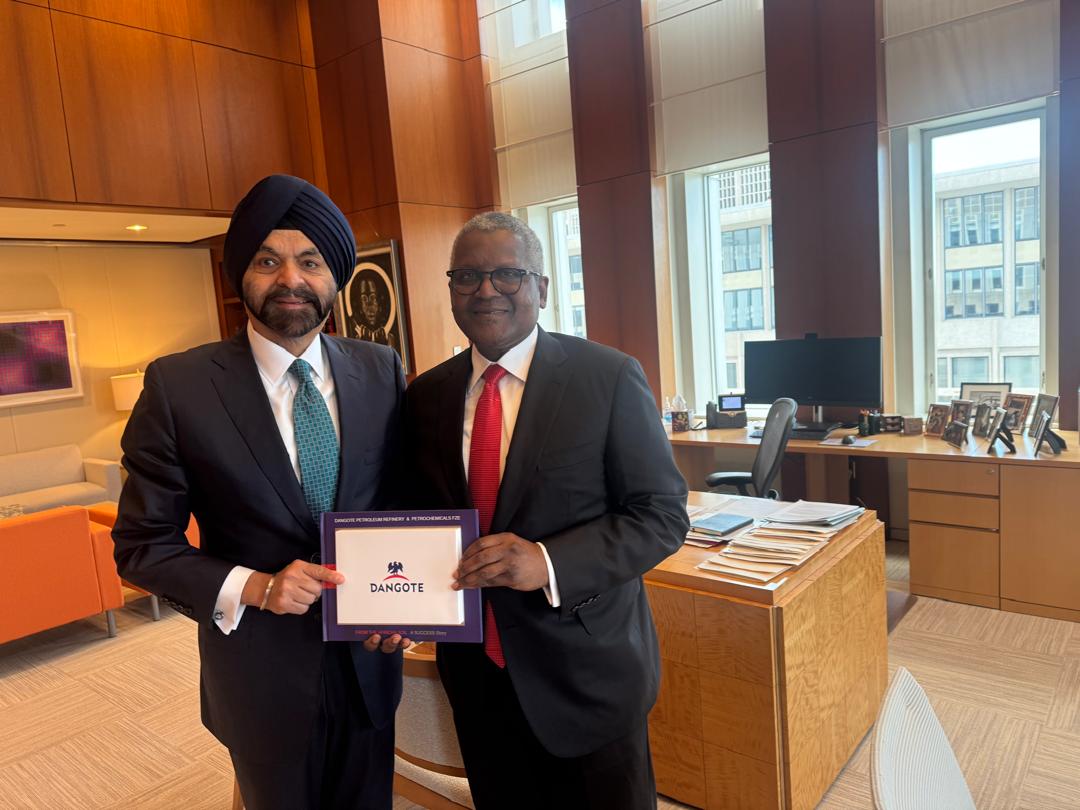
World Bank Chief Meets Dangote After Controversial Report Raises Refinery Monopoly Concerns
World Bank President Ajay Banga met with Aliko Dangote, President and Chief Executive of Dangote Industries Limited, on Tuesday at Dangote’s office on the sidelines of the IMF/World Bank Group Spring Meetings in Washington D.C.
The meeting came just days after a World Bank report triggered controversy in Nigeria by warning that the country’s fuel market had effectively become dependent on a single refinery, raising concerns about competition, pricing, and energy security.
In its April 2026 Nigeria Development Update, released on 7 April, the Washington-based institution urged the Nigerian government to reopen its petrol market to competition by restoring import licences.
“The suspension of import licenses since January 2026 has reduced competition, allowing prices to exceed import-parity levels,” the report said. “Allowing qualified marketers to resume imports would restore competition, reduce pricing distortions, and better align domestic prices with global benchmarks. Greater market contestability would also strengthen supply security by reducing reliance on a single refinery and broadening sourcing options, while remaining consistent with domestic refining objectives.”
The bank noted that the Dangote refinery had become “the main supplier of refined petrol after the regulator ceased issuing import licenses in early 2026.” It added that the refinery had raised its ex-depot price of PMS to about N1,275 per liter as of 23 March 2026, compared to an estimated import-parity price of around N1,122 per liter — an implied differential of roughly 12 percent.
The publication of the report on the World Bank’s website on 7 April was followed by a wave of media coverage focusing on its call for the reinstatement of petrol import licences and its implicit warning about overreliance on the Dangote refinery. The document was taken down two days later apparently because of its recommendation.
On 9 April, the World Bank issued a statement clarifying its position. While acknowledging that the report had recommended allowing petrol imports, the institution appeared to row back from any immediate push for liberalisation in light of global geopolitical risks.
“Given current global energy supply disruptions, such recommendation may run counter to efforts that countries around the world are undertaking to ensure their energy and national security,” the Bank said.
Instead, the World Bank stressed that, in the short term, Nigeria’s priority should be cushioning vulnerable households from the impact of high fuel prices, using existing social protection mechanisms.
“In the case of Nigeria, the focus should be to provide targeted support to the most vulnerable people through their well-functioning social safety net system, and the World Bank Group stands ready to step up its existing support,” it stated.
However, the bank maintained that, over the longer term, market reforms remain necessary: “Over time, transitioning toward a competitive retail market for Premium Motor Spirit is an important policy direction that requires a well-sequenced implementation strategy that guarantees the quality and standards of all petroleum products.”
The World Bank also sought to signal continued support for both the Nigerian government and domestic private investors, including Dangote, in efforts to stabilise fuel supplies.
“The World Bank Group recognizes the efforts of the Government of Nigeria and the Nigerian private sector in taking concrete steps to safeguard fuel supply — a foundation that is essential to protect consumers and businesses,” the statement added.


