
Nigerians’ appetite for foreign education tempered by pricier dollar
By Mary Adenike
Nigerians’ appetite for foreign education has been dampened as the high cost of sourcing dollars pushed up the naira equivalent of tuition fees.
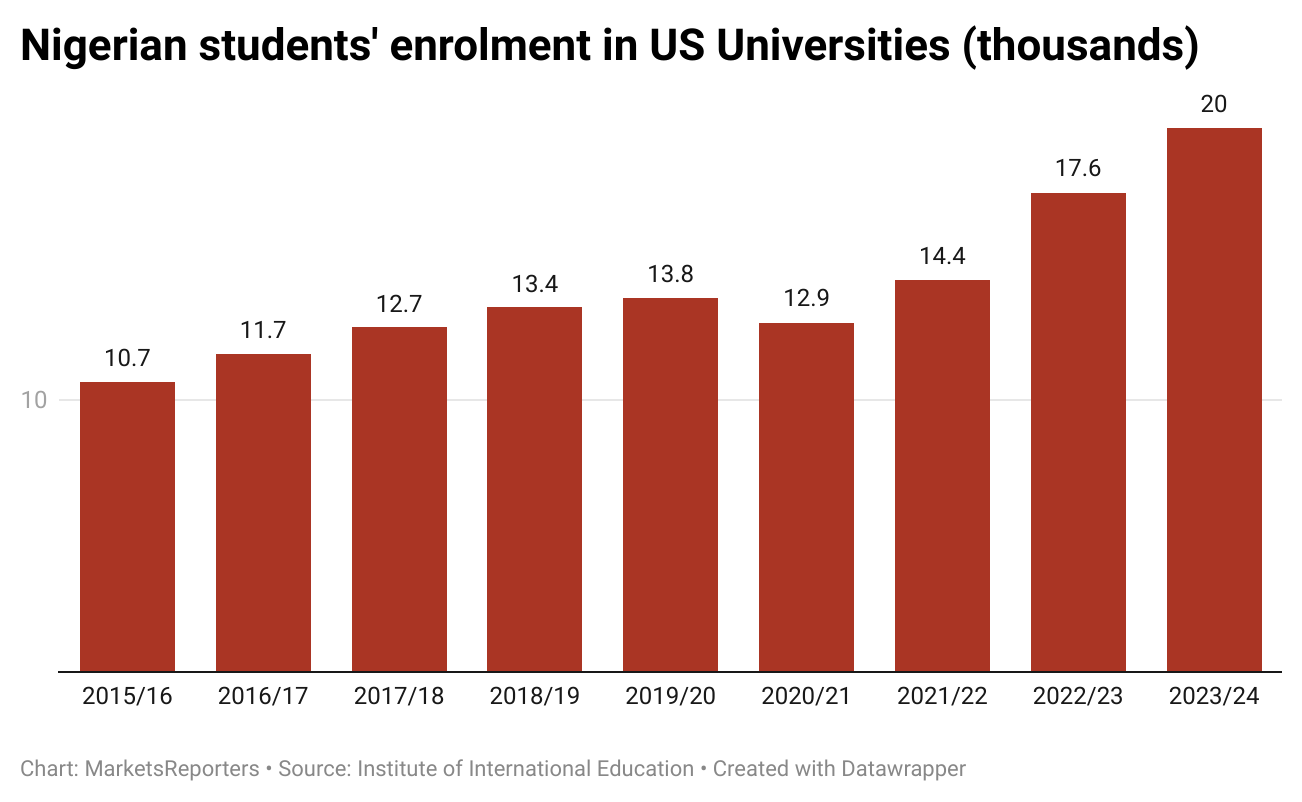
The number of Nigerian students at US colleges and universities rose by 13.5 percent to 20,029 in the 2023/24 academic year, compared to an increase of 22.2 percent in the previous year, according to Markets Reporters’ analysis of the latest data from the Washington-based Institute of International Education.
Data from the Central Bank of Nigeria shows that the utilisation of forex for foreign education dropped by 470 percent to $38.2 million in the first quarter of 2024 from $218 million in the same period of 2023.
“The data is not surprising as the volatility of foreign exchange has been something else. Parents are removing their children from foreign schools after one year of schooling and putting them in private ones here,” Uchenna Uzo, professor of marketing and faculty director at Lagos Business School, said.
Nigeria retained its spot as the only African country among the top 10 countries with the highest number of students in America. India (331,602), China (277,398), South Korea (43,149), Canada (28,998), and Taiwan (23,157) are the top five countries.
IIE said the US hosted 1.14 million international students during the academic year, a seven percent increase compared to the previous academic year. It includes international students enrolled at US higher education institutions, online from abroad, and on Optional Practical Training.
Uzo said concerns about likely changes in immigration policies following the emergence of a new US president may have also affected the emigration plans of many Nigerians. “This year, we may see a marginal drop.”
The naira has lost more than 70 percent of its value against the dollar following two sharp devaluations since July 2023, making overseas studies more expensive for Nigerians.
During a panel discussion at a 2025 annual outlook conference last week, Tope Fasua, special adviser to the president on economic affairs (office of the vice president), said that the depreciation of the naira has reduced the number of Nigerians migrating from the country.
“The devaluation, or rather the depreciation of the naira that we’ve seen since our government came, is double-edged, actually, in terms of its impact. On one hand, it has impacted inflation, but on the flip side, it has reduced the ‘Japa’ rate,” Fasua added.
Mounting economic challenges such as high inflation, unemployment, and fragile economic growth and insecurity have fueled the exodus of Nigerians, popularly known as ‘japa’ (a Yoruba word for ‘flee’), with higher education and work as the major routes.
The forex reform implemented by the President Bola Tinubu administration saw the naira plunge from N463.38/$1 in June 2023 to 1,547.58/$1 on January 17, 2024 at the official market. At the parallel market, it weakened to 1,665/$1 from 575/$1.
International students in US universities spend on average $25,000-$55,000 per year on tuition fees, depending on the course, type of university, and location. This translates to N38.7 million and N85.1 million, using the official market rate. This is many times costlier than many private universities in Nigeria whose tuition fees range from N700,000 to N8 million per session.
Federal and state government-owned universities charge less than N200,000-N300,000 per session.
Education in Africa’s most populous nation, especially in the tertiary sector, is plagued by infrastructure deficit, incessant strikes by lecturers, and cultism, among other challenges.


