Foreign Investors Flee Nigerian Stocks, Erasing Tinubu-Era Gains
Foreign share of trading on the Nigerian Exchange in the first 10 months of the year fell to its lowest in at least 13 years, wiping out the gains recorded earlier in President Bola Tinubu’s administration, according to data compiled by Markets Reporters.
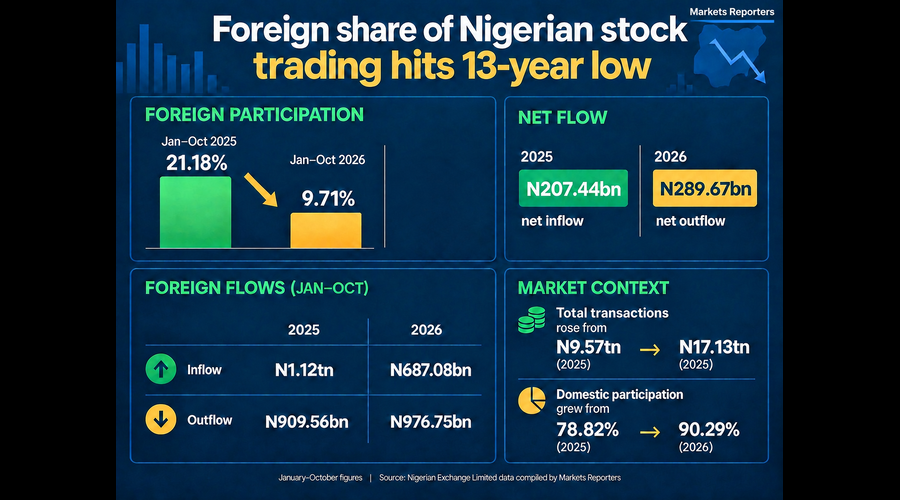
Foreign share of trading on the Nigerian Exchange in the first 10 months of the year fell to its lowest in at least 13 years, wiping out the gains recorded earlier in President Bola Tinubu’s administration, according to data compiled by Markets Reporters.
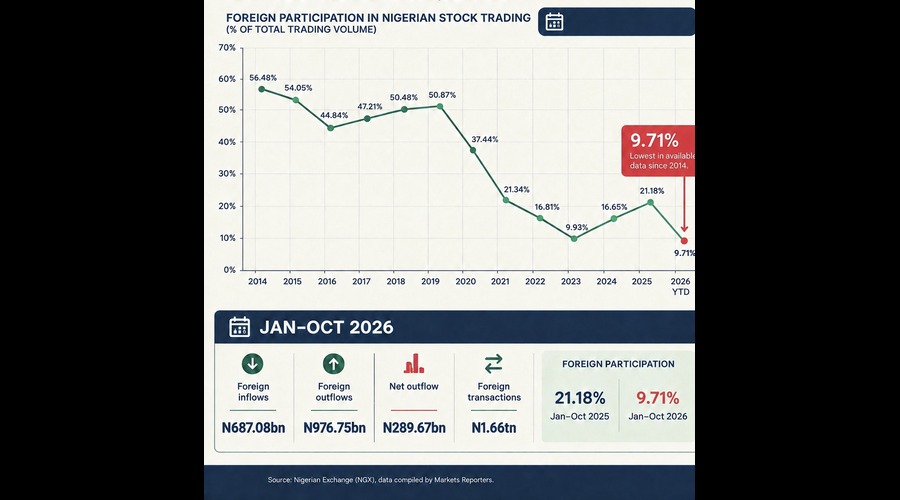
Data from the Nigerian Exchange Limited (NGX) shows that foreign participation fell to 9.71% from 21.18% a year earlier and 16.65% in 2024. It is now below the 9.93% recorded in 2023, the year Tinubu took office in May.
Overseas investors pulled out of the stock market faster than they came in. Between January and October, the market recorded a net foreign outflow of N289.67 billion as against a net inflow of N210.44 billion in the same period last year.
Foreign transactions fell 18.2% to N1.66 trillion, from N2.03 trillion in the same period of 2025. Inflows fell about 38.7% to N687.08 billion, while outflows rose about 7.4% to N976.75 billion.
Despite the foreign exit, overall trading nearly doubled. Total transactions rose to N17.13 trillion from N9.57 trillion in the same period of 2025.
Domestic investors drove the growth. Their share of trading rose from 78.82% to 90.29%.
The latest figures continue a decline that has lasted more than a decade. In 2014, foreign investors accounted for 56.48% of market activity, and their share stayed around 50% until 2019. It then fell to 37.44% in 2020, 21.34% in 2021 and 16.81% in 2022.
The reforms early in the Tinubu administration, including unifying the exchange rate, briefly reversed the trend.