‘Uganda Needs Dangote’: Minister Pitches Refinery Project, Others to Africa’s Richest Man
Uganda has asked Nigeria’s Dangote Group to take a leading role in its planned 60,000-barrel-per-day oil refinery and to invest in fertiliser and salt production.
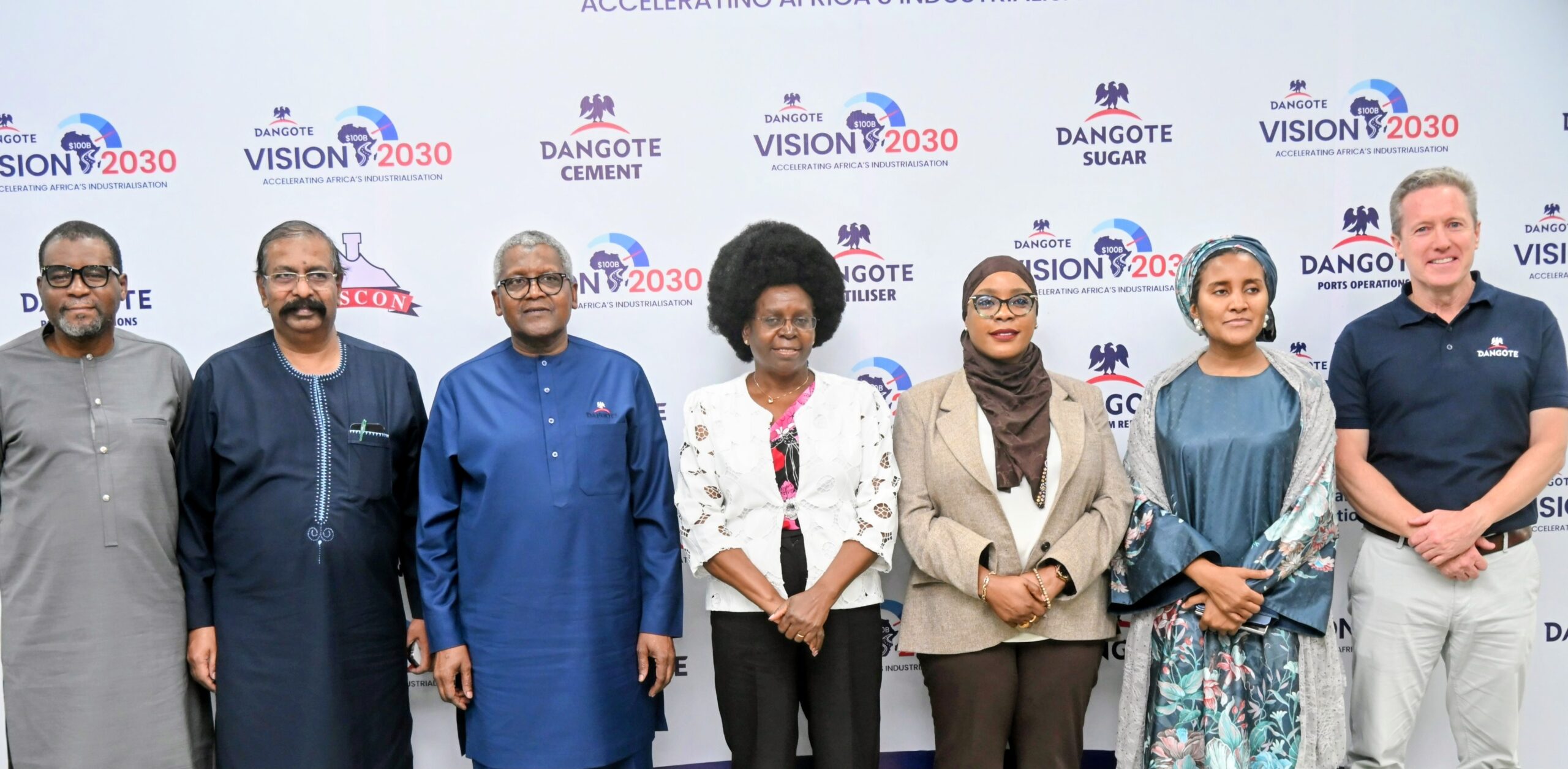
Uganda has asked Nigeria’s Dangote Group to take a leading role in its planned 60,000-barrel-per-day oil refinery and to invest in fertiliser and salt production. The aim is to use the conglomerate’s industrial experience to turn the East African nation’s natural resources into finished goods, create jobs and cut its reliance on imports.
“Our crude, our phosphate, our salt are waiting to be turned into fuel, fertilisers and chemicals here in Africa and in Uganda by Africans,” said Hajjat Amina Mukalazi, Uganda’s Minister of State for Finance, Planning and Economic Development (Privatisation and Investment).
Mukalazi made the pitch during a visit to the Dangote Petroleum Refinery & Petrochemicals and Dangote Fertiliser Limited in Lagos. She led the delegation with Monica Musenero Masanza, Minister of Energy and Mineral Development. Both ministers pledged government support for the proposed partnership, according to a statement from Dangote on Sunday.
Mukalazi called the proposed refinery in the Hoima area a major industrial priority for Uganda. She said it would benefit from the group’s experience in engineering, building and running large industrial plants.
“You have shown that an African company can build world-scale industry in Africa and run it by Africans themselves,” she told her hosts.
She noted that the delegation’s estimates would still need a technical assessment by Dangote’s team. She also argued that a Ugandan refinery could complement the group’s planned refinery in Lamu, Kenya. Under that model, Hoima would serve inland markets and the coastal Lamu plant would supply maritime and coastal markets.
The delegation also presented opportunities in fertiliser blending, phosphate processing and salt manufacturing. It described these as connected investments that could share infrastructure and distribution networks.
Musenero said fertiliser was a particular opportunity. Uganda has suitable mineral resources, she said, but has struggled to turn them into finished products.
“We also have minerals that can be used to produce fertilisers, but our efforts to convert those resources into fertilisers have not been very successful. Here, we have seen a very large fertiliser manufacturing facility,” she said. “This is Africa-to-Africa collaboration. We believe Dangote can operate very successfully in Uganda.”
Musenero said the Lagos facilities set a new benchmark for African industrial ambition.
“This is setting a new standard for African thinking and for what we believe we can achieve. Sometimes, we think too small,” she said. “After our discussions and seeing the scale of these facilities, I wish I could convince him to fly back with us so that we could start tomorrow.”
She said Uganda wanted an early follow-up visit and that the proposed collaboration already had political backing.
Mukalazi invited Dangote to visit Uganda for further talks. She promised that the government would work to remove obstacles to investment.
“Uganda needs Dangote, and now is the right time. Our country is ready and moving rapidly towards industrialisation,” she said. “He would bring investment, technology and opportunities for local participation, as we have seen here today. He has demonstrated what is possible elsewhere, and we believe he can do the same in Uganda.”
She said the benefits would go beyond capital to include skills development, jobs and opportunities for local businesses.
“As the minister responsible for investment, I want to assure Alhaji Dangote that the government will support his investment and work to remove bottlenecks,” she said. “Beyond the investment itself, there would be opportunities for knowledge transfer and employment, particularly for young people.”
David Bird, Managing Director and CEO of Dangote Petroleum Refinery & Petrochemicals, said the presence of two ministers showed how serious Uganda is about an industrial partnership.
“Uganda has incredible natural resources and human capital. As both ministers have expressed during this visit, there is also no shortage of ambition or political will to pursue industrialisation,” he said.
Bird said the meeting was a chance to find common interests and explore collaboration as part of the group’s wider expansion plans.
“The visit demonstrates the strength of the relationship and the importance attached to identifying common ground, exploring opportunities and strengthening our expansion into East Africa as part of Vision 2030,” he said.
More from Economy
See all → Economy
Dangote Raises Bet on Africa to $70bn, Plans 10,000MW Power Push
 Economy
Nigeria Posts Biggest Decline in Jollof Cost Since 2016
 Economy
Global Rating Firms Lift Nigeria’s Debt Outlook Amid Economic Reforms
 FEATURED