
Nigerian drugmakers’ fortunes improve on forex stability, waivers
By Mary Adenike
Some major Nigerian pharmaceutical companies reported an improvement in their financial performance for 2024 largely due to foreign exchange stability and the suspension of import duties on medical supplies.
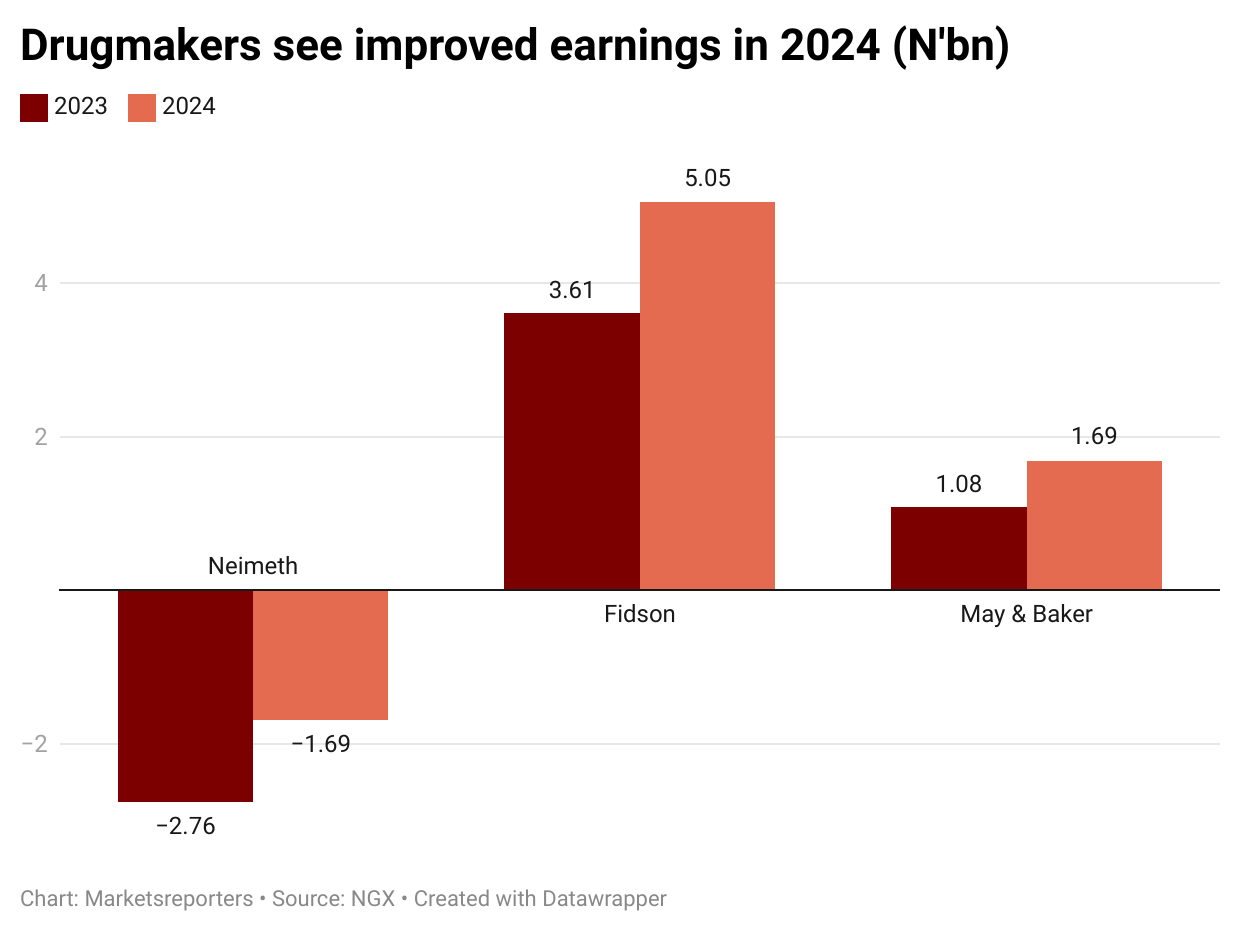
MarketsReporters’ analysis of the latest unaudited financial statements of Fidson Healthcare Plc and May & Baker Plc shows that their combined after-tax profit rose to N6.73 billion in 2024 from N4.69 billion in 2023 while Neimeth International Pharmaceuticals’ loss narrowed to N1.69 billion from N2.76 billion.
In 2023, the firms reported a decline in their earnings due to the scarcity of forex that pushed up importation costs and prices of drugs.
The firms’ total revenue grew year-on-year by 56.8 percent to N117.6 billion in 2024 from N75 billion, while their combined cost of sales jumped to N72.3 billion from N46.6 billion.
Africa’s most populous nation relies heavily on imported drugs, active pharmaceutical ingredients, and equipment used in drug manufacturing from China, India, Malaysia, and the Netherlands.
Pharma West Africa, a major pharmaceutical exhibition in Africa, said that over 70 percent of medicines in Nigeria are imported, with medicines accounting for a chunk of the country’s total healthcare spend of $10 billion.
The naira, which has lost more than 70 percent of its value against the dollar following two sharp devaluations since July 2023, worsened FX liquidity challenges, leading to a scarcity of pharmaceutical raw materials and an increase in the prices of drugs.
According to the International Trade Centre, a multilateral agency, the importation of pharmaceutical products into Nigeria fell to$704.6 million in 2023, the lowest in five years, from $1.05 billion in the previous year.
Difficulty in securing imports pushed some multinationals like Sanofi and GlaxoSmithKline (GSK) to exit the country last year. Both companies said they would adopt a third-party distribution model to continue product supply in Nigeria.
In 2024, the average one dollar to naira exchange rate at the official market was N1,450, higher than N645.1 in 2023. Although the exchange rate is still high, the Central Bank of Nigeria’s recent efforts to unify exchange rates and improve forex availability have contributed to relative stability in the FX market.
“This stability which started mid-last year and the gradual shift towards local substitutes gives some level of advantage over those who are importing. Also, recall that the government introduced some waivers to ease the cost of importations for pharmaceuticals,” Muda Yusuf, director and CEO of the Centre for the Promotion of Private Enterprise, said.
A recent half-yearly review report by the Manufacturers Association of Nigeria said the sector’s local raw material sourcing rose to a four-year high of 56.03 percent in the first half of 2024 from 55.4 percent in the same period of 2023.
“This modest increase indicates a gradual shift towards local sourcing, driven by difficulties in obtaining foreign exchange,” the report said.
In June of last year, President Bola Tinubu introduced an executive order to suspend import duties and value-added tax on essential medical supplies imported into the country.
Experts in the pharmaceutical industry noted that the high cost of locally produced pharmaceuticals would ease and importation would increase, improving the earnings of many manufacturers.
“The policy might increase imports because when prices are reduced, it will stimulate demand, leading to the production of raw materials, intermediaries, or finished goods,” Sam Ohuabunwa, immediate past president of the Pharmaceutical Society of Nigeria, said.


