
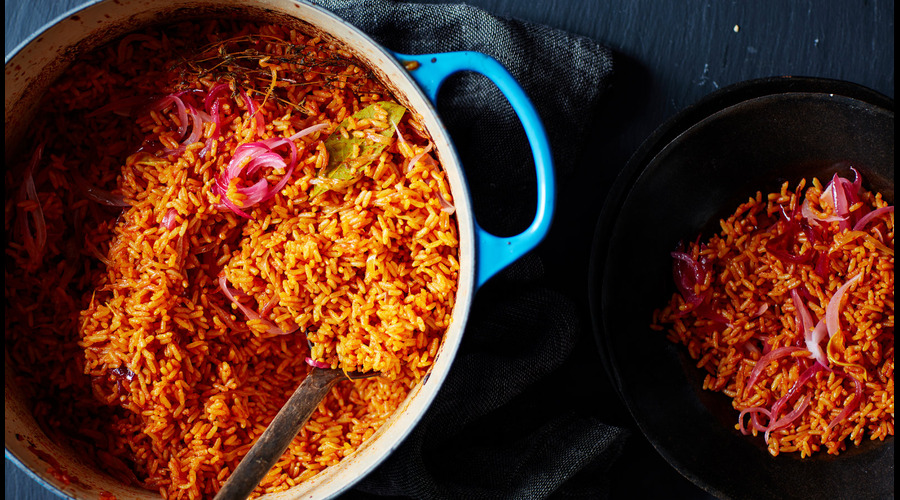
Iran War Drives Cost of Nigerian Jollof to 10-Year High
The cost of preparing a pot of jollof rice for a Nigerian family of five has climbed to its highest level since tracking began in 2016, as the ripple effects of the Iran war cascade through fuel, transport and food prices.
New data from SBM Intelligence, an Africa-focused geopolitical research and strategic communications firm, shows the average cost rose by 19.4 percent to N30,435 in the six months to March 2026, driven by sharp increases in rice, vegetable oil and protein.
At current levels, a single pot of the staple dish now consumes more than 40 percent of Nigeria’s minimum wage, highlighting the deepening cost-of-living crisis.
The surge also marks a reversal from September, when the index recorded its first decline since February 2018.
“The Iran war was the trigger, not the cause,” the report said. “The rapid pass-through from the Strait of Hormuz into pump prices, transport fares and market shelves has re-exposed structural fractures that have gone unaddressed for a decade.”
According to the National Bureau of Statistics, headline inflation edged up to 15.38 percent in March from 15.06 percent in February, ending an 11-month disinflation streak. Food inflation — which accounts for more than half of the index — rose to 14.31 percent, its highest level in five months, reversing the brief relief seen earlier in the year when it dropped to a single digit of 8.89 percent in January for the first time since 2016.
Rural areas recorded the sharpest increases, underscoring how rising transport costs disproportionately affect less-connected regions.
The Jollof index tracks price changes across 13 markets in Nigeria’s six geopolitical zones, using the cost of ingredients such as rice, groundnut oil, chicken or turkey, beef, seasoning, pepper, tomatoes, salt, and onions. It excludes December due to seasonal variations.
Energy shock feeds directly into food inflation
The conflict, which began on February 28, sent Brent crude prices from $82 to above $110 per barrel within three weeks, amplifying pressures in an import-dependent fuel market.
Despite being a crude producer, Africa’s most populous nation imports nearly all its refined petroleum products, leaving it highly exposed to external shocks. Petrol prices in Lagos jumped from about N830 to N1,325 per litre, while Abuja saw levels as high as N1,367. Diesel — critical for logistics — surged past N1,500 per litre.
The knock-on effect has been immediate: transport fares doubled or tripled, while the cost of moving a tonne of grain from Kano to Lagos rose from N45,000 to N70,000. Every component of the jollof basket — whether locally produced or imported — has become more expensive to transport, store and sell.
Regional divergence widens
Price pressures have intensified across Nigeria’s major cities. The index shows Abuja markets recording double-digit increases, Lagos spiking 23 percent in a month, and Port Harcourt completing a six-month climb of 55 percent.
But Ghana has experienced a more stable trajectory. The average cost of a pot of jollof stood at GHS435.50 in March 2026, largely unchanged from GHS437.50 in September, supported by relative currency stability thanks to record high gold prices.
In dollar terms, the divergence is stark: Nigeria’s index has risen to 151.3 relative to its 2023 baseline, while Ghana’s stands at 98.3.
Households forced into survival mode
Across Nigeria, households are rapidly adjusting consumption patterns in response to rising costs.
Consumers are abandoning bulk purchases, reducing meal frequency, and substituting expensive proteins like beef and chicken with cheaper alternatives such as eggs, crayfish and dried fish. Cooking habits are also shifting, with many switching from gas to charcoal or sawdust stoves to cut energy costs.
In some cases, families are turning to subsistence strategies, including backyard farming, to reduce reliance on volatile market prices.
SBM argues that while the Iran war triggered the latest spike, the underlying drivers are structural: weak logistics infrastructure, heavy reliance on imported fuel, and limited policy buffers.
“The jollof pot has become the most honest ledger of policy failure,” the report noted, highlighting how external shocks continue to transmit quickly into domestic prices.
Policy responses, the firm said, have remained largely reactive. Nigeria has maintained tight monetary policy without targeted interventions to stabilise transport or food prices, effectively leaving households to absorb the full impact.
What needs to change
SBM analysts say the solution lies in structural reforms that reduce exposure to fuel shocks and improve food distribution. Expanding rail freight would help decouple food logistics from diesel-powered transport, while strategic grain and fuel reserves could provide buffers during crises. Strengthening agricultural extension services and storage infrastructure would also reduce post-harvest losses and stabilise supply.
At the same time, there is a growing need to align monetary policy with food affordability, ensuring that exchange-rate management does not come at the expense of basic living standards.


